Sign of the times: Stories of different women scientists across the 20th century
Jocelyn Bell Burnell, the physicist who discovered pulsars, said that roughly half of her auto-biography focused on her experiences of being “a woman physicist of her generation”.
This phrase has stayed with me and inspired this article. Working at Cambridge in the 1960s, what kind of ‘generation’ was she part of?
This led me to think: What about Henrietta Leavitt at Harvard, researching as early as the 1890s? And Lise Meitner’s work in Berlin, as her country was on course toward the Second World War? What also about the “generation-impact” on Bibha Chowdhuri, an Indian-born particle physicist studying in the UK and France as they are in full war effort? Finally, what about Chien-Shiung Wu, a brilliant Chinese nuclear physicist and daughter of a Chinese elementary school principal, in the US in the 1970s?
A common red thread of questions runs: How does the political context of colonial times, the Second World War, and the Cold War interfere with the research passions of these scientists?
By investigating this red thread question, I hope to give insight into how historical workplaces embraced the contribution of female physicists, and believed them to enrich the field, even when many other environments did not. How did these environments come to exist? And if they did exist, that leads us to question ourselves: have these environments reappeared, disappeared or just changed?
The value of this discussion lies in saying something more about these physicists than “She stood in the shadow of her husband/supervisor” or “She was denied a Nobel Prize”. A patronising tone which, albeit often true, I hope to avoid. The history of systematic discrimination is undeniable, and its central points remain valid: a lack of mentorship and respect, and distorted self-worth as taught by society.
The context in which we are looking back at history today is one in which the data remains disorganised. Before starting the research for this article, I had a good idea of the kind of data that would be interesting: I wanted to compare the number of female physicists and students at institutes in the Soviet Union, China, India, and the US between the 1960s and 1990s, and further compare the pay gaps with respect to male scientists. However, I quickly found that even broad strokes of this data are almost impossible to find. We are not looking back, but we are not moving forward either: stagnation seems to be the sign of OUR times. Universities seem somewhat confused as to how to proceed beyond their “Women in STEM” events once a year. In light of the aforementioned data gap, I want to suggest that it is in the domain of “Legacies” that a lot of tangible impact can be made in combating systematic discrimination that has been rendering some faculty members invisible for decades. It most certainly helps universities address patriarchal foundations, not to forget that clarifying the contribution of those invisibilised, even 50 years later, is a duty of science.

Where there were records, women scientists were often noted as “technical assistants” or the like, a connotation that has left their careers largely undocumented. If only these women didn’t have to work undercover, I could’ve read newspaper articles, biographies, and award speeches, yet now I rely on some rare interview excerpts to gain insight into their stories. The stories mentioned span from the 1890s to the 1970s, though they are the same in the sense that they are all marked by great mental stamina; they do differ in the way they shake patriarchal foundations, a good reminder that perspective-shifts are inherent to each attempt at listening closely.
Let’s start in 1868, Henrietta Swan Leavitt is born and will go on to solve the mystery of whether a star was very close or very bright by formulating the Period-Luminosity Relationship. This is mind-blowingly early, given that the life expectancy in the United States at the time was around 31 years. [1] She becomes an interesting lived example of Oscar Wilde’s phrase : “We are all in the gutter, but some of us are looking at the stars”. [2]
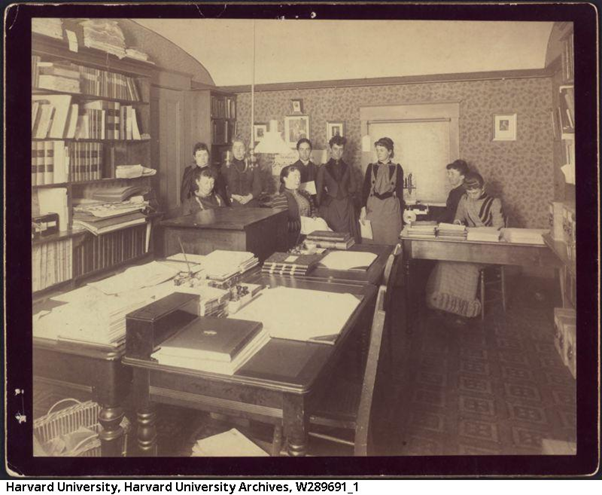
After graduating in astronomy, Leavitt struggled to find paid work, so she volunteered as part of the group of women we now know as the “Harvard Computers”. Within the university they were “skilled workers”, casually exploring the universe better than anyone before.
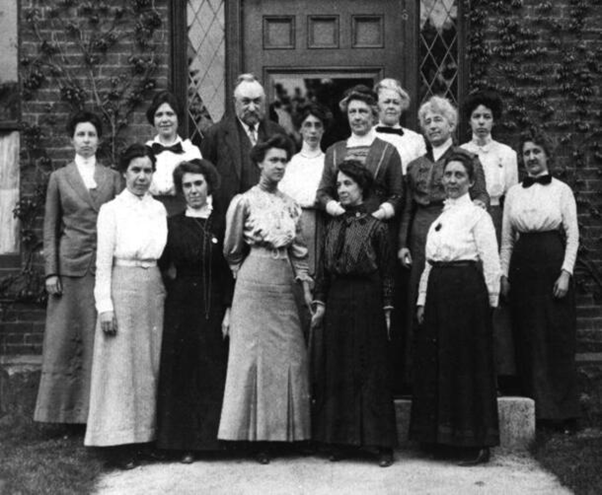
“Even my maid could do this job” – complained Edward Pickering on the sloppy cataloguing of his male colleagues. His maid Mary Fleming took him by the word, as if she had been waiting for him to say this, and promptly started a lab that would grow to employ 80 women.
Together, the Harvard computers classified over 45’000 stars. They could do so, because Pickering, in an act of accidental feminism hired women as “skilled workers”. He could pay them half of a man’s salary and hire double, it came to a staggering 30 cents per hour, 5 cent more than the observatory salary for women. [3] Arguably, more importantly, he understood what was Leavitt’s intellectual property; though she couldn’t submit papers herself, Pickering mentioned Leavitt in the first sentence of her paper in his name.[4]
Around the time when Leavitt’s career came to an end, Lise Meitner’s began in Vienna.
She delivered an inaugural speech on the problem of cosmic physics. The newspaper stepped in to rectify what was, in their understanding, an obvious mistake and printed the only seemingly possible correct title of “Problems of cosmetic physics”. In a 1959 interview, her supervisor Otto Hahn in telling this story, said: “she was just too pretty”. Meitner, sitting next to him in this interview, says nothing. [5]
Maybe she was wondering if they would also discuss her outfits from 1933 until now, and if maybe after that the discussion could shift to her passion: nuclear fission. In this interview, it eventually did. Her life as a researcher changes in July 1938: the Nuremberg Race Laws have been enforced in Vienna and Lise Meitner, a Jew, must flee to Sweden. There, she continues to work and write letters while Hahn and Strassmann stay in Berlin and chemically discover that nuclear fission of uranium and thorium can occur, by proving the presence of a product: Barium. They did not, however, understand why until the year after, when Meitner and her nephew provided the theoretical explanation of fission via an exothermic process.
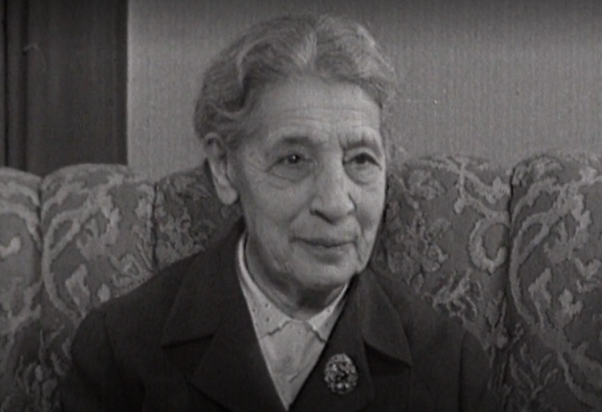
Otto Hahn and Lise Meitner remained friends, albeit with tensions. Hahn received the Nobel Prize in Chemistry without mentioning Meitner, who was nominated 49 times in her lifetime but never won. [6] After the war, Meitner wrote to friends about Hahn: “He absolutely suppresses the Nazi crimes and is thereby led to wrong conclusions”. On another occasion: “Hahn suppresses the past with all his might, and I am part of that suppression”. [7]
Meitner was invited to the US for a conference honouring her work. Truman said to her: “So you are the little lady responsible for all of this.”[8] I can picture Lise Meitner’s unimpressed expression. One that she probably kept as she declined work on the Manhattan Project or a teaching position at a US university of her choice. Meitner’s epitaph in the UK really echoes her career as “A physicist who never lost her humanity”.
Another physicist whose work was influenced by the politics of the time was Bibha Chowdhuri. Though we cannot ascertain her career as it would’ve evolved if not for her setting in the colonial and WW2 context, we can suggest that it would’ve been significantly different, also if she were a man, moreso because she’s a woman. Chowdhuri earned her MSc in Colonial India in the city of Kolkata at the age of 23. She then joined Prof. Debendra Mohan Bose in Kolkata, despite his belief that his research was “unsuitable for women”. Suppose eventually, he forgot, and they could get to work and publish a set of three groundbreaking papers in Nature together, all on the topic of a photographic method of estimating the mass of the Mesotron. [9]
After a shortage of photographic plates in India stalled their research, Chowdhuri relocated to Manchester to pursue her PhD. [10] One article states that the discrimination she faced “was not much different in the West”. The fact that she earned her doctorate 16 years after her master’s degree hints at this being true; her career was marked by detours related to her gender and ethnicity, as well as world wars. [11]
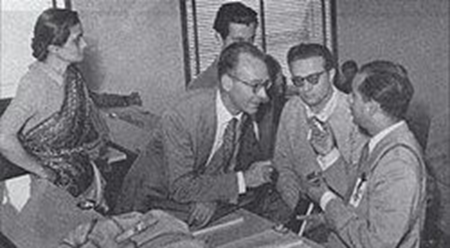
A few additional indicators help us better imagine Chowdhuri’s working environment. One natural question to ask is whether she benefited from a supportive community of female colleagues—something akin to the group of women astronomers around Henrietta Leavitt, which had existed some fifty years earlier. The answer given by the picture, unfortunately, is an unequivocal no.

A Manchester Herald article in 1948 writes: “Meet India’s New Woman Scientist – She Has an Eye for Cosmic Rays”. Written in a tone that is both curious and condescending, the article portrays Chowdhuri as a novice—a label that stuck with her even after 20 years in the field. Chowdhuri eventually returned to India, where she worked at the Tata Institute of Fundamental Research (TIFR). The fact that this Institute is linked to industry giant Tata Steel rather than the Indian government adds yet another political layer to what her best employment option was effectively. [13]
Cambridge physicist. C. F. Powell won the Nobel Prize in 1950 “for his development of the photographic method of studying nuclear processes and his discoveries regarding mesons made with this method”. He used full-tone photographic emulsion plates that he procured easily, because he was in the UK and not in India. The striking resemblance to the aforementioned three papers, published seven years earlier with titles such as “A Photographic Method of Estimating the Mass of the Mesotron”, is mentioned peripherally in a book published ten years later. Astonishing fair play there, Powell.
Today, Chowdhuri’s work is remembered as “contributing heavily” to the discovery of the K-meson subatomic particle. She has a memorial in Kolkata and a dwarf white star named after her. What she doesn’t have is a mention in physics classes, not even in her birthplace, Kolkata. I started learning about her after watching a video of a physicist from Waterloo speaking about her surprise at never having heard of Chowdhuri, when they were both from the same region in India. [15, 16]
Chowdhuri’s story highlights the issue of legacy. This concern also resonates with Jocelyn Bell Burnell, as reflected in the opening quote of her autobiography, where she describes herself as a “woman physicist of her generation”. She writes about her womanhood in relation to her studies in Cambridge, where she started in 1967, a decade after Chowdhuri. After insisting on the unusual nature of a particular signal amid three miles of paper data from a radio telescope, she made the ground-breaking discovery of a pulsar.
In 1973, Bell Burnell received the Albert A. Michelson Medal jointly with her supervisor, Antony Hewish. However, she was not mentioned in 1974 when he received the Nobel Prize for the same work. A wave of sympathy for Bell Burnell did not seem to have a tangible impact on her status. Reflecting on her career, and the legacy of her discovery, she writes:
“I didn’t always have research jobs. Many of the positions offered to the astrophysicist throughout her career focused on teaching, administrative duties, and management.”
Later, when she had a child, she wrote: “It was extremely hard combining family and career.” Maternity leave would only be enshrined in UK law in 1975. [17] What Bell Burnell said 50 years ago still resonates today, as her words cover the political dimension of achieving equality beyond quotas, including issues such as maternity leave, the protection of intellectual property, gender pay gaps, and discrimination reporting procedures.
Finally, we come to the fascinating example of Chien-Shiung Wu and her work on parity violation. Wu came to the US from China to study at Berkeley for one year. She was then offered a PhD in Nuclear Physics in Michigan, yet when upon arrival she found out that the University of Michigan didn’t let women walk through the front door of their student union hall, she promptly went back to Berkeley. This is commented in the Oakland Tribune newspaper in 1941, in a way that doesn’t spare comments on her appearance:
“A petite Chinese girl worked side by side with some top US scientists in the laboratory studying nuclear collisions. This girl is the new member of the Berkeley physics research team. Ms. Wu, or more appropriately Dr. Wu, looks as though she might be an actress or an artist or a daughter of wealth in search of Occidental culture.” [19]
The “girl” worked with almost every Nobel Prize winner at the time and even married her husband at the home of one of them. Among her collaborators were Segrè, Pauli and Fermi, and when time allowed, she would likely have had coffee with Oppenheimer, whom she affectionately called “Oppie”. On this note, I would’ve seen fit to invite the author of the Oakland Tribune article back on to list the number of immigrant “petite girls” with full security clearance on the Manhattan project.
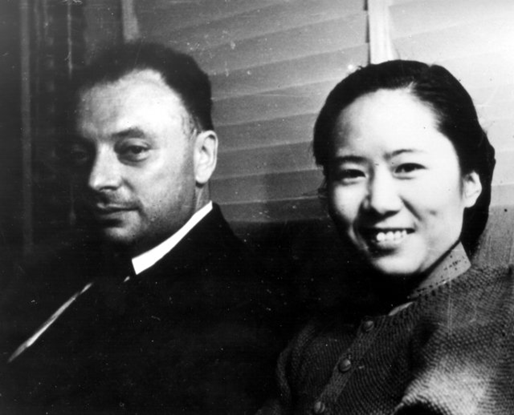
Wu would return to China when possible. She reflects below on her experience working in science in both countries with the words:
“In China, there are many, many women in physics. There is a misconception in America that women scientists are all dowdy spinsters. This is the fault of men. In Chinese society, a woman is valued for what she is, and men encourage her to accomplishments, yet she remains eternally feminine.” [20]
I find Wu’s point to be still so relevant today. As a community, we are only very slowly detaching ourselves from the seemingly inherent belief that the amount of physics in a person is directly proportional to their resemblance to Einstein. I, just like Wu, wouldn’t score so well; this is likely because Einstein didn’t wear socks (see his ETH locker), and Wu (see picture) and I (you need to trust me) mostly do.

Chien-Shiung Wu continued talking about Women in science, among others in an MIT speech that I would love to read but couldn’t find anymore. Wu died at 82 in New York and was buried, as was her wish, in the girls’ school in Taicang that her father founded. About her grandmother, Wu’s granddaughter wrote:
“It is a constant. People, institutions, and countries want to claim her, just as I still want to claim her, in an asymmetrical universe where the reality of a person is not the same as the image of them that stretches on through space and time. I accept that a much larger part of who she was is completely unknowable and belongs to everybody.” [21]
I believe this is a feeling shared by many female physicists today who are looking for the stories of role models who we know existed, but whose stories have been lost over time. I echo the introduction: From 1890 to the present day, symbolising the unresolved grief felt over the stories of the invisible women who were not preserved. Astonishingly, Leavitt was part of a community of female colleagues more than a hundred years ago. Marie Curie won the Nobel Prize in 1903, nonetheless all the other women mentioned in this blog post are still remembered as “pioneers” throughout their careers in the 20th century. For a woman scientist looking back today, tracing the long way we’ve come is rendered difficult by an ongoing erasing of the continuity of women’s scientific work.
I take Lise Meitner’s patient look as well as Burnell’s and Wu’s more impatient accounts of waiting as women scientists for the conversation to shift from their dress to our passion for physics. Together, it seems we are doing a sort-of “aligning” work in various degrees, making up for distracting segways into the appearance of the physicist. Women physicists plus a “when do we start ?” look stand to remind naturally that what really matters about the look of a physicist, which is fundamentally: that their thinking brain is appropriately packaged inside a body. This is convenient since quickly cheackable an hence really not that distracting.
While writing this, I took some steps towards attuning myself to a respectful discussion of these women as physicists, and I hope that research into their experiences continues. We can learn from the past for the benefit of today’s community, and we have started. With the Higgs discovery paper having more than 5000 authors, it is very clear that our age is one for genuine scientific collaboration. Since 2016, there is a clearer positive trend for the number of female PhDs, postdocs, assistant professors, and full professors at ETH Physics. [22]
This is good news for ETH overall, since a study found that gender-heterogeneous working groups received an average of 34% more citations than homogeneous ones. [23]

Written by Tilly Schaaf, on behalf of WiNS ETH Zurich
Bibliography
[1] Statista. (n.d.), Life expectancy of the United States (all-time),Retriev. 27.10.25 https://www.statista.com/statistics/1040079/life-expectancy-united-states-all-time/
[2] Wilde, O. (1893). Lady Windermere’s fan: A play about a good woman. London, UK: Elkin Mathews and John Lane.
[3] The Crimson. “Women in Computing: The Pioneers of Harvard’s Observatory.” The Crimson, September 26, 2019. https://www.thecrimson.com/article/2019/9/26/women-computers-observatory/.
[4] Pickering, E. C., (1908).Periods of 25 Variable Stars in the Small Magellanic Cloud.Harvard College Observatory Circular, No. 173, pp. 1–3.
[5] NDR. (1960, January 1). Aus erster Hand: Atomforscher Otto Hahn, Lise Meitner und Fritz Strassmann im Gespräch [Video]. ARD Mediathek. (ardmediathek.de)
[6] The Nobel Prize. (n.d.). Nomination archive: Person details. https://www.nobelprize.org/nomination/archive/show_people.php?id=6097
[7] Sime, R. L. (1998). Lise Meitner: A life in physics. University of California Press.
[8] Arte. (2021). Geniale Frauen [Web series] https://www.arte.tv/de/videos/090626-026-A/geniale-frauen/
[9a] Bose, D.M.; Chowdhey, Biva (1941a). Origin and Nature of Heavy Ionization Particles Detected on Photographic Plates Exposed to Cosmic Rays. Nature. 147: 240-241. https://doi.org/10.1038/147240a0.
[9b] Bose, D.M.; Choudhuri, Biva (1941b). A photographic method of estimating the mass of a mesotron. Nature. 148: 259-260. https://doi.org/10.1038/148259a0.
[9c ]Bose, D.M.; Choudhuri, Bibha (1942). A Photographic Method of Estimating the Mass of the Mesotron . Nature. 149: 302. https://doi.org/10.1038/149302a0.
[10] Whastic. (2020, August 15). Bibha Chowdhuri – A forgotten legend [Audio podcast]. Whastic
[11] Bhattacharya, A. (2018, November 25). The woman who could have won a Nobel: Despite being a pioneer in the study of cosmic rays in India, Bibha Chowdhuri remains practically unknown. The Telegraph India.
[12] “Bibha Chowdhuri.” Wikipedia, The Free Encyclopedia. Last edited 26 May 2025. Accessed 3 November 2025. https://en.wikipedia.org/wiki/Bibha_Chowdhur
[13] Priya, S. L. (2018, November 27). This brilliant woman could have won a Physics Nobel for India. Yet few Indians know her story. The Better India.
[14] Suprakash C. Roy “Bibha Chowdhuri: A Jewel Unearthed: The Story of an Indian Woman Scientist.”, 2018
[15] By Salil Kumar Mukherjee – Own work, CC BY-SA 4.0, URL: https://commons.wikimedia.org/w/index.php?curid=156964725*
[15] Perimeter Institute for Theoretical Physics. (2025). The Hidden Universe: Women Who Shaped Modern Physics [Video]. YouTube.
[17] Lee, J. J. (2013). 6 women scientists who were snubbed due to sexism. National Geographic.
[18] Chiang, Tsai-Chien (2014). Madame Chien-Shiung Wu: The First Lady of Physics Research. World Scientific. 978-981-4374-84-2.
[19] Oakland Tribune. (1941, April 25). Outstanding research in nuclear bombardments by a petite Chinese lady. Oakland Tribune (Oakland, CA), p. 49.
[20] American Association of University Women. (n.d.). Chien-Shiung Wu overlooked for Nobel Prize. Faces of AAUW.
[21] Yuan, J. (2021, December 13). Discovering Dr. Wu: The world reveres Chien-Shiung Wu as a groundbreaking nuclear physicist who made a startling find 65 years ago. But to me, she was Grandma — and I long to know more about her private universe. The Washington Post.
[22] ETH Zürich. (n.d.). Equality Monitoring [Webpage]. Staffnet.
[23] Campbell, L. G., Mehtani, S., Dozier, M. E., & Rinehart, J. (2013). Gender-heterogeneous working groups produce higher quality science. PLOS ONE, 8(10), e79147. https://doi.org/10.1371/journal.pone.0079147
Image Credits
[1] Percent of PhDs Awarded to Women in Specific Fields: American Institute of Physics –https://www.aip.org/statistics/women-in-physics-and-astronomy-2019
[2] Edward C. Pickering and a the “Computers”: Harvard-Smithsonian Center for Astrophysics – https://hea-www.harvard.edu/~fine/Observatory/fcushman.html
[3] Computation Long Room: Harvard-Smithsonian Center for Astrophysics – https://hea-www.harvard.edu/~fine/Observatory/fcushman.html
[4] Meitner Interview: ARD Mediathek – https://www.ardmediathek.de/video/aus-erster-hand/atomforscher-otto-hahn-lise-meitner-und-fritz-strassmann-im-gespraech/ndr/Y3JpZDovL25kci5kZS81MDYwXzE5NjAtMDEtMDEtMDAtMDA
[5] Chowdhuri at Manchester University: Wikimedia Commons – https://commons.wikimedia.org/wiki/File:Bibha_Chowdhuri_at_the_International_Conference_in_Pisa,_Italy_1955.jpg
[6] International Conference on Elementary particles in Mumbai: Wikipedia – https://de.wikipedia.org/wiki/Datei:Group_photo_of_the_International_Conference_on_Elementary_Particles_held_in_Mumbai_between_14%E2%88%9224_December_1950,_taken_at_OYC.jpg

[7] Wolfgang Pauli sitting with Chien-Shiung Wu: X – https://x.com/phalpern/status/1355256756688007169/photo/1
[8] Wu’s family at Claremont Avenue: The Wahington Post – https://www.washingtonpost.com/lifestyle/2021/12/13/chien-shiung-wu-biography-physics-grandmother/